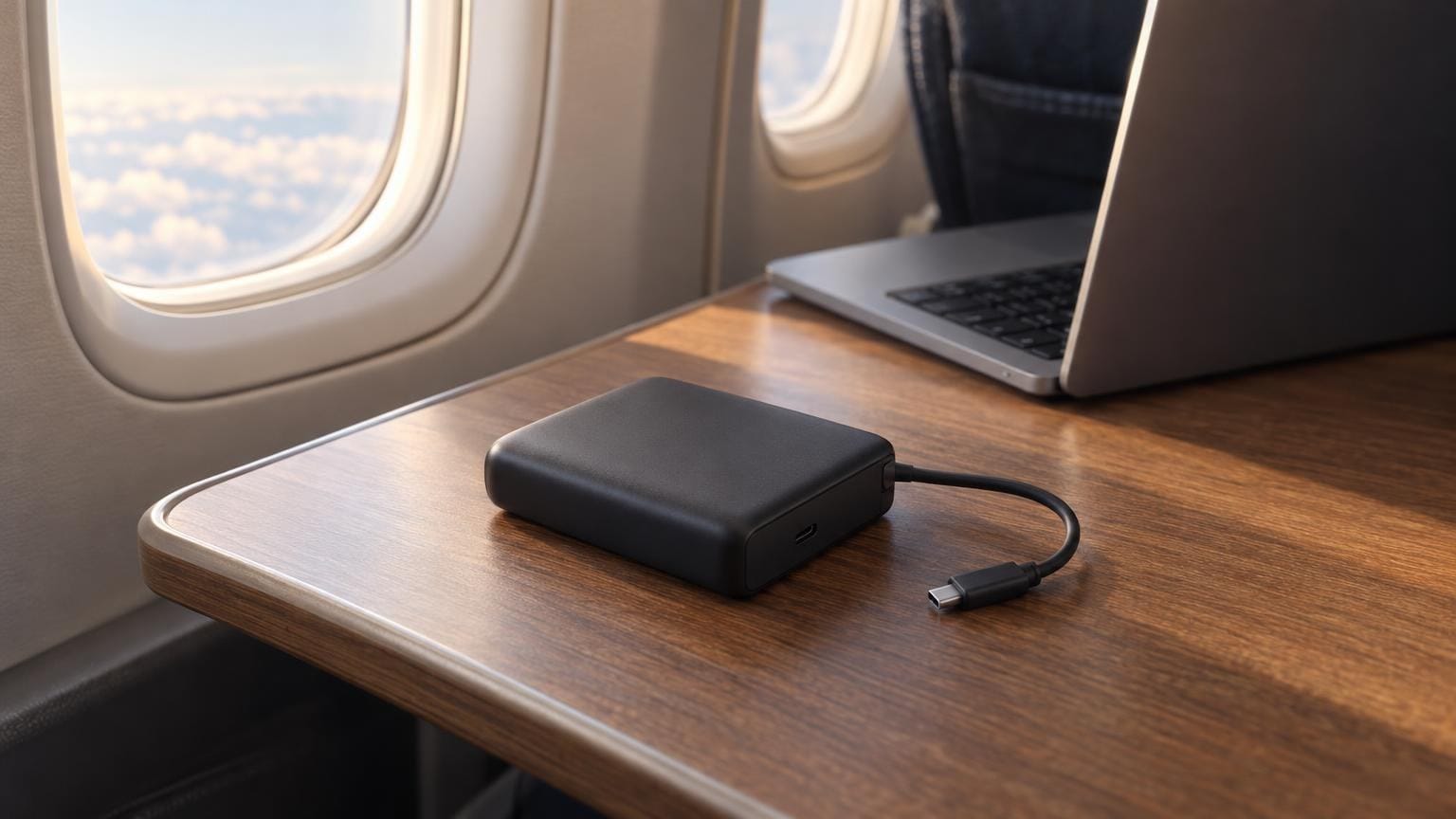
Airplane outlets are scarce and phone batteries die fast. The Anker 20K power bank with the built-in USB-C cable is designed for exactly that problem: multiple devices draining at once, no cables to juggle, and a need for fast charging on the move.
The pack promises fast charge speeds across multiple devices and a compact shape that fits in a daypack.
Why the Anker 20K Power Bank Stands Out
Travelers who run a phone and a laptop at the same time often find themselves choosing between a lightweight phone-only bank and a bulky laptop charger. The A1383 tries to split that difference: a 20,000mAh cell, up to 87W total output, and a built-in USB-C cable that removes the need to carry a separate lead.
Lighter phone-only power banks cannot touch a laptop, and dedicated laptop chargers require a wall outlet. The built-in USB-C cable and high output are the main reasons this model draws attention from travelers who want one device to cover both.
Key Features
This Anker power bank is positioned as a travel backup and daily bag option. It balances serious charging power with a simple, no-fuss design that mostly delivers, though a few trade-offs are worth knowing before buying.
High-Powered 87W Charging
The Anker 20,000mAh power bank pushes up to 87W total output, enough to revive a laptop and phone together without hobbling either. According to Anker’s product page, a single USB-C port or the built-in cable can each deliver up to 65W when used alone, which covers most thin-and-light laptops. The USB-A port handles up to 22.5W on its own.
According to Anker’s product page, the bank recharges fully in about 1.5 hours when paired with a 65W charger. The Anker Singapore listing notes that using a 30W PD fast charging adapter at 25°C takes around 4.5 hours instead, so the recharge time depends heavily on the adapter used.
Built-in USB-C Cable
The built-in USB-C cable is a convenience for anyone packing light, removing the need to carry an extra lead. The cable stores neatly against the body of the bank, though its fixed position means less flexibility if a longer or angled cable is needed for an awkward port.
TechRadar notes that the short, flat built-in cable can feel awkward to position depending on the setup, and some owners report the cable does not flex enough for their liking. For most travel scenarios owners find it practical, but it is worth knowing before buying.
20,000mAh Capacity and Recharge Speed
The 20,000mAh cell capacity is designed to handle multiple full phone charges and still have enough to give a tablet a useful boost during a long day. The Anker Singapore listing explains that conversion losses reduce what actually reaches devices, and estimates delivered capacity at around 11,000 to 14,000mAh from a full charge. Actual results depend on the device and conditions, so treat that as a range rather than a guarantee.
TechRadar’s hands-on review reports that its test used 30% of the bank’s indicated charge to charge a Pixel 7a once, and cautions that usable output and phone-charge count depend on the devices and test conditions.
Port Layout and Simultaneous Charging
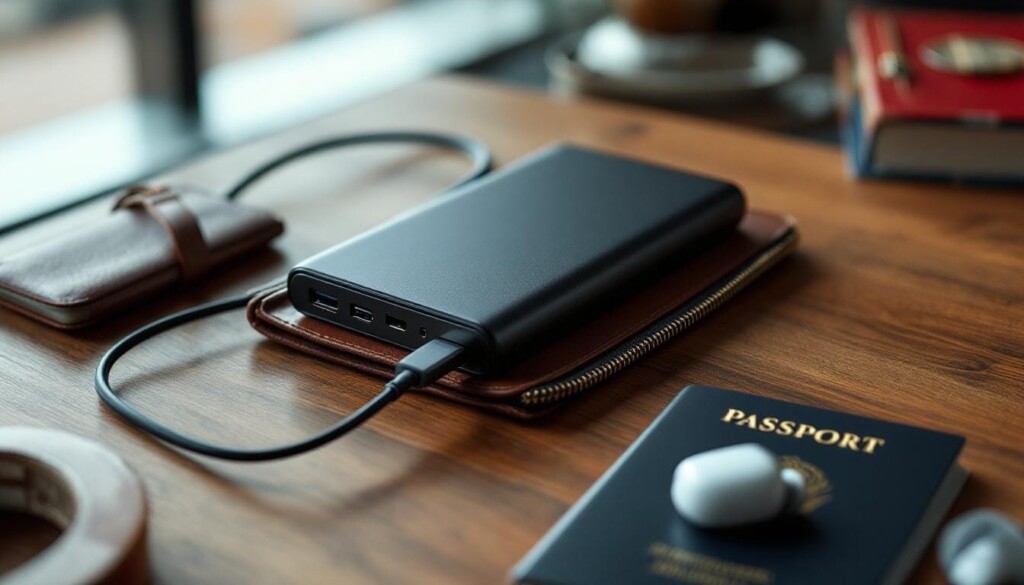
The A1383 has one built-in USB-C cable, one USB-C port, and one USB-A port. According to Anker’s user guide, the built-in cable and the USB-C port each handle both input and output, while the USB-A port is output only.
The headline 87W total is not available from every combination. Anker’s guide lists the output splits this way: the built-in cable plus the USB-C port together reach up to 87W; the cable plus USB-A reaches up to 82.5W; the USB-C port plus USB-A reaches up to 24W; and running all three outputs at once gives up to 84W, split as 60W plus 24W across the ports. Full-speed laptop charging works best when the laptop is the only device connected.
Airline Travel and TSA Rules
The A1383 falls under the 100Wh limit that most airlines require for carry-on power banks, which is why Anker’s page describes it as approved for airline carry-on travel.
Airline and aviation authority rules can change, and the limit that applies depends on the specific carrier and route. Anker’s page does not replace the rules of a particular airline, so confirming with the carrier before travel is the right step. Power banks are generally required to travel in carry-on luggage, not checked bags; verify the applicable rules for any specific flight.
Real-World Use: On the Move
Best Buy’s review summary reports that buyers praise fast charge performance and the built-in cable, while some find the unit heavy. TechRadar describes the bank as solidly constructed and finds the additional ports add convenience alongside the built-in lead.
The single built-in cable limits flexibility if different connectors are needed at once. The multi-port output means a phone and a second device can be fed simultaneously, and the bank can be recharged from an outlet while still charging a device.
TechRadar calls it a large “brick” but says the power output is useful for laptops and other devices. Some Amazon reviewers report devices stopping charge intermittently after months of use, while others report reliable long-term operation. These are individual reports, not a measured failure rate.
Pros and Cons
Pros
- 20,000mAh capacity is designed to last through travel days, with multiple phone charges and enough for a tablet boost on longer trips.
- Anker describes the bank as approved for airline carry-on travel, under the 100Wh flight limit.
Cons
- Heavier than small phone-only power banks, adding noticeable weight to an everyday carry kit or travel pouch. Anker’s support description gives the weight as 430.91g.
- The built-in cable is convenient but the fixed length can be awkward in some setups, and it cannot be swapped if it wears out. TechRadar and some owners flag this as a real limitation.
- Getting the roughly 1.5-hour recharge speed Anker’s product page claims requires a 65W adapter, which means carrying that adapter as well.
- It does not replace a full laptop charger for heavy workstation use. Real-world top-up speed is useful, but full sustained laptop loads can still be limited.
Who This Is For (And Who Should Skip It)
Travelers who carry a laptop or juggle multiple devices are the target audience for the Anker 20K power bank. The built-in USB-C cable and high output make charging a laptop and phone at the same time practical when outlets are scarce, which is the scenario this bank is built for.
Skip it if featherweight gear for pocket carry is the priority; it is noticeably heavier than phone-only chargers. Also pass if laptop charging is never needed or if fully removable cables are preferred.
One model in Anker’s current lineup that goes further is the Prime Power Bank (20K, 220W), model A110B, which offers up to 140W from a single USB-C output and adds a display and app control. The sources do not call it a direct replacement for the A1383; both are listed on Anker’s site.
Recall Status and Safety
This comes up often, so it is worth addressing directly. An iTechGuides recall summary lists several Anker models that have been subject to recalls, including A1263, A1257, A1647, A1652, A1681, and A1689. The A1383 does not appear on that list. A TechEngage roundup specifically distinguishes the A1383 from the recalled A1647 and A1689 models.
No recall notice for the A1383 was found in the available sources. Recall status can change, and the model number on a specific unit matters, so checking Anker’s current recall page and confirming the model number on the unit directly is the right step.
Final Verdict
The Anker 20K power bank (A1383) is a strong choice for travelers who need to charge a laptop and phone from a single portable device.
The weight is the main trade-off. At around 431g it is not a pocket carry option, and it earns its place in a day bag or carry-on rather than a jacket pocket. For ultralight trips where only a phone needs topping up, a smaller bank makes more sense. For multi-day travel or any trip where a laptop might run low, this one delivers on its core promise.
Anker’s U.S. product page lists it at around $70. Check Amazon for the current price, since it varies by market and changes over time.
Frequently Asked Questions
These are the questions that come up most often from readers researching this power bank for travel and daily use.
How long would a 20K power bank last?
The cell capacity is 20,000mAh, but the Anker Singapore listing explains that conversion losses reduce what actually reaches devices, estimating delivered capacity at around 11,000 to 14,000mAh from a full charge. Actual results vary by device and conditions.
Is there a recall on the Anker power bank 20000?
Several Anker power bank models have been recalled, but the A1383 does not appear on the recall lists in the available sources. An iTechGuides recall summary and a TechEngage roundup both distinguish the A1383 from the recalled A1647 and A1689 models. Recall status can change, so checking Anker’s current recall page and confirming the model number printed on the specific unit is the right step.
What are the actual charging capabilities of the Anker 20,000mAh power bank with 87W output?
The Anker 20,000mAh power bank delivers up to 87W total across its ports, with a single device able to draw as much as 65W from the USB-C port or built-in cable when used alone.
The listed 20,000mAh is the cell capacity, not the usable energy after conversion losses.
Does the Anker 20,000mAh power bank support fast charging for devices like tablets or laptops?
Yes. It supports high-power USB-C fast charging that will fast-charge many tablets and some smaller laptops. The bank’s built-in cable means one less lead to pack when topping up a phone or laptop on the road..
Very power-hungry laptops, such as full-size 16-inch models under heavy load, may only get a partial charge or slower top-ups. Fast charging also requires the device to accept the bank’s power profile.
Can the A1383 charge a laptop, and what is the maximum output?
Yes, the A1383 can charge a laptop. According to Anker’s product page, the USB-C port and the built-in USB-C cable each deliver up to 65W when used alone, which covers most thin-and-light laptops. The maximum total output across all ports is 87W, reached when the built-in cable and USB-C port are used together. For the fastest laptop charging, connecting the laptop as the only device gives the best result, since sharing ports reduces the power available to each device.
Can the Anker 20,000mAh power bank charge multiple devices simultaneously, and how effective is it?
Yes. According to Anker’s user guide, the built-in cable plus the USB-C port together reach up to 87W, while running all three outputs at once caps at 84W split as 60W plus 24W. The port limits above set the real-world performance for combinations like phone plus earbuds or phone plus tablet. For full-speed laptop charging, a single-device connection gives the best result.
What are the weight and portability aspects of the Anker 20,000mAh power bank for travel?
Anker’s support description gives the weight as 430.91g and the dimensions as 15.75 by 7.35 by 2.6cm. TechRadar describes it as a large “brick” but notes the solid construction. The built-in cable reduces what needs to be packed separately, which offsets some of the extra weight for travel. If minimalist everyday carry is the priority, this may feel bulky; for reliable multi-device backup on trips, the size-to-output ratio is a reasonable trade-off.
Are Anker power banks good quality?
As with any consumer electronics product, individual experiences vary.