
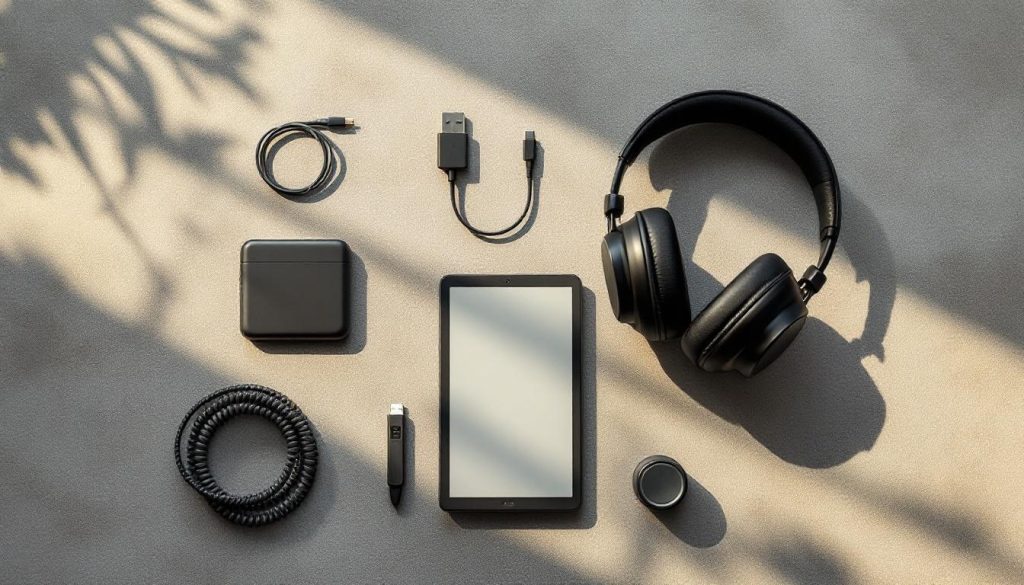
Travel used to mean stuffing a bag with chargers, adapters, and backup batteries, then hoping nothing died mid-flight or got lost between terminals. Now, the top travel tech gadgets can help with the usual headaches: dead phones, tangled cables, outlet shortages and lost luggage. Keep your packing list in check by choosing only the ones that fix a problem you actually have.
I chose the picks in this guide from maker specifications and from what each gadget is designed to solve: dead phones, tangled cables, outlet shortages and lost luggage. I own the Kindle Paperwhite and the Samsung Galaxy SmartTag2, so those two entries come from my own use. The rest are research-based picks, and I say so where it matters.
1. Anker Nano Power Bank 20K (30W), The All-in-One Traveler
Anker’s support page lists a 20,000mAh model, which is the capacity range that makes sense for a weekend trip or a long-haul day without a wall outlet.
Anker’s support listing shows two USB-C ports and one USB-A port. USB-C input and output are rated up to 30W, USB-A output up to 18W, and combined output up to 24W. Anker lists it at 153.4 × 71.6 × 28.1mm and 462g. Anker also has a separate 20K/30W version with a built-in USB-C cable, and its support specifications describe that one with up to 22.5W from the USB-A port, so check which version the listing you buy matches.
Best for: Commuters and travelers who want high capacity for multiple days of phone use. If you want the best portable charger for a long travel day, this is the pick.
Anker Nano Power Bank 20K (30W)
2. Sony WH-1000XM5, Turn Chaos Into Quiet
The Sony WH-1000XM5 is the research-based pick for the specific chaos of travel. Airport announcements, engine drone and crying babies are exactly what active noise cancellation is built to dial down.
The noise cancellation is the main reason to pick these for flights. Sony lists closed dynamic headphones with 30mm drivers, Bluetooth 5.2, SBC, AAC and LDAC codecs, and a 10m Bluetooth range. Sony rates battery life at up to 30 hours with noise cancelling on and 40 hours with it off, with about 3.5 hours to charge over USB. Sony gives the weight as about 250g.
The main drawback is that these headphones sit at the premium end of the price range, and that premium only pays off if you travel regularly. If you fly once or twice a year, cheaper options may make more sense. Check Amazon for the current price.
These are for frequent travelers who want reliable noise cancellation and are happy to pay extra for sound quality. Business travelers and digital nomads get the most value here.
Sony WH-1000XM5
3. Samsung Galaxy SmartTag2, Smarter Luggage Insurance
The Samsung Galaxy SmartTag2 is a compact Bluetooth tracker that clips onto your luggage, keys or backpack and connects to Samsung’s SmartThings Find network. It works without a subscription fee, which makes it more affordable than GPS-based alternatives over time.
The tracker uses Bluetooth Low Energy to communicate with nearby Galaxy devices, creating a crowdsourced network that can pinpoint your belongings even when you’re not nearby. I found it surprisingly effective for tracking luggage during travel, especially in airports where Samsung phones are common.
The biggest limitation is compatibility. Samsung says SmartTag2 requires a Samsung account and registration in SmartThings Find, with compatible Galaxy phones or tablets running Android 9 or later, and that UWB features require a UWB-enabled Galaxy device. If you don’t own a Samsung phone or tablet, this tracker won’t work for you.
Samsung lists Bluetooth LE 5.3 plus UWB, a Bluetooth range of up to 120m, IP67 dust and water resistance, a buzzer, and a replaceable CR2032 battery rated for up to 500 days. It weighs 13.75g and measures 28.8 × 52.44 × 8.0mm.
This tracker is ideal for Samsung users who frequently check bags or want peace of mind tracking valuables without ongoing subscription costs. I wrote a full review of these here.
Samsung Galaxy SmartTag2
4. Nomad Lane Bento Bag, Order for Your Tech
The Nomad Lane Bento Bag is a 24L bag built around keeping tech gear organized during travel.
Nomad Lane lists a 24L capacity, a weight of 2.76lb (1.25kg), space for a laptop up to 16 inches, a bottle pocket and a trolley sleeve. The listed included items are a removable adjustable shoulder strap, a key leash, a toiletry pouch and a tech pouch. That toiletry pouch plus a tech pouch means chargers and cables get proper storage instead of jumbling around loose.
The trade-off is weight. If you’re counting ounces for ultralight travel, 2.76lb might feel excessive. Check Amazon for the current price.
This works best for travelers who want one bag that handles both organization and capacity. It suits business trips or weekend getaways where you need tech gear accessible without digging through layers of clothes.
Nomad Lane Bento Bag
5. Insta360 X5, Capture Everything, Decide Later
The Insta360 X5 is a 360° action camera that records in every direction at once, letting you pick your framing after the fact. The appeal is simple: record a street market or a hiking trail, and decide later which angles actually matter.
Insta360 lists 1/1.28-inch sensors and 360° recording options including 8K at 30, 25 or 24 fps, 5.7K at up to 60 fps, and 4K at up to 120 fps, plus Active HDR and InstaFrame modes. The real advantage is app-based editing: the listing says you save 360° clips and reframe or edit them later in the Insta360 app. It removes the stress of getting the shot right in the moment.
The listing says standard and premium lens covers are sold separately, and the camera connects over USB-C 3.0.
This works best for travelers who want flexible framing options without carrying extra gear or stopping to adjust shots constantly.
Insta360 X5
6. Kindle Paperwhite (Waterproof), One Device, Endless Downtime
The Kindle Paperwhite is waterproof and built for reading anywhere without worrying about accidental drops in water. Amazon lists an IPX8 rating, tested for immersion in up to 2m of fresh water for up to 60 minutes.
The glare-free display mimics real paper, which makes reading comfortable even in bright sunlight or dim cabins. I’ve found the adjustable warm light particularly useful for reading before bed without straining my eyes.
That said, this device does one thing only: reading. You can’t browse the web, check email, or multitask. Amazon lists Bluetooth audio with VoiceView accessibility and Audible audio support, but a subscription is not specified on the product page.
It’s ideal for travelers who want to carry multiple books without the weight, or anyone looking to read by the pool without phone distractions. You’ll need to purchase or borrow books separately. Check Amazon for the current price.
Kindle Paperwhite (Waterproof)
7. Anker 735 GaN Charger, One Charger, Fewer Cables
The Anker 735 delivers up to 65W total through two USB-C ports and one USB-A port, so a laptop, phone and earbuds can share a single wall outlet.
Anker lists the 735 Charger (Nano II 65W) with 100 to 240V input and dimensions of 1.50 × 1.15 × 2.60 inches. A single USB-C port can output up to 65W. Anker also lists a separate 735 GaNPrime 65W model, A2668, with a foldable US plug and PPS, so check the exact model on the listing you buy.
The catch is power distribution. The 65W is a total, so when several devices are plugged in at once, the wattage splits and a laptop charges more slowly. You also still need to carry the right cables, since this replaces power bricks, not the cables themselves.
Best for: Travelers who carry multiple devices and want to consolidate chargers. If you’re bouncing between airport lounges and cramped hotel desks, this solves the outlet shortage problem.
Anker 735 GaN Charger
8. Nomad Base Station Hub, One Spot, Everything Charged
Nomad’s support page lists three magnetic charging coils, an 18W USB-C PD port and a 7.5W USB-A port, and says it can charge up to four devices at once, two wirelessly and two wired.
Nomad lists compatibility with iPhone 8 and later, Qi-enabled Google and Android devices, MagSafe alignment for iPhone 12 and later, AirPods wireless-charging cases, AirPods Pro, and Samsung Galaxy Buds and Buds Live. The stated size is 165 × 107 × 13.3mm and the weight is 438g. The box includes the hub, a braided 1.5m nylon power cord, and a regional EU, UK or AUS adapter.
The main downside is price.
This works best if you travel with multiple Apple devices and value desk space over budget. If you only charge one or two things, a simple cable does the job for less.
Nomad Base Station Hub
9. EPICKA Universal Travel Adapter, One Plug, Any Country
The EPICKA Universal Travel Adapter is a research-based pick for travelers who want one adapter instead of researching outlet standards for every destination.
This adapter works best for frequent international travelers who carry multiple devices and want to consolidate their charging setup into one compact unit.
EPICKA Universal Travel Adapter
10. Lander Traveler Backpack (35L), Built for the Elements
I picked this travel backpack because it bridges the gap between rugged outdoor gear and urban travel.
Lander lists a 35L capacity, a roll-top cargo section, a full-length zipper opening, a laptop compartment that fits up to 19 inches, a water-bottle sleeve and a shoe compartment sized up to men’s 13. Listed dimensions are 12.2 × 21.3 × 3.9 inches and the weight is 3lb. Lander also describes interior cable-routing channels in the laptop compartment and exterior straps.
Best for: Adventure travelers who need their tech to survive the wild.
Lander Traveler Backpack (35L)
How Travel Tech Gadgets Actually Makes a Difference
The best travel tech doesn’t just add convenience. It eliminates friction points that drain your time and energy. Reliable gear prevents mid-trip failures, and the best upgrades solve problems you didn’t realize you could fix.
Saving Time with Smarter Automation
Travelers fumble with adapters, wait for devices to charge one at a time, and manually track luggage through airport chaos. With the SmartTag2, Samsung’s SmartThings Find app shows your tag’s location, so you can check your phone instead of hunting down airline staff.
Automation that saves time:
- One-tap currency conversion through travel apps
- Auto-adjusting noise cancellation that responds to ambient sound
- Scheduled device charging that stops at 80% to preserve battery health
Reducing Stress Through Reliability
Gear that works when connections fail is gear worth trusting. The difference between gadgets that work and those that sound impressive on paper comes down to reliability under real conditions.
Paper backups help, but real-time position tracking on a downloaded map avoids wrong turns and backtracking.
For wireless earbuds, the key metric isn’t total battery life.
What Actually Matters When Upgrading Travel Tech
Skip upgrades that add features you won’t use. The best improvements target specific pain points rather than chasing specs.
Weight and size matter more than raw power for frequent travelers, and a gadget that is easy to pack gets used more often than one that stays at home.
Battery life under load tells the real story. Judge battery figures against what you will actually do on the trip, not an idle test with Wi-Fi off.
Compatibility across regions prevents that moment when a charger doesn’t fit EU outlets. Universal travel adapters work, but built-in multi-region compatibility in one compact unit beats carrying adapters for every possible socket type.
| Upgrade Priority | Why It Matters | Skip If |
|---|---|---|
| Fast charging support | You always have outlet access | |
| Water resistance (IP67) | Survives rain and spills during outdoor trips | You stick to cities and hotels |
| Offline functionality | Works without Wi-Fi or cellular in remote areas | You visit connected destinations only |
The upgrades worth buying solve problems you actually face, not theoretical scenarios from marketing copy.
Travel Essentials Most Packing Lists Forget
The best travel gadgets are only half of a good kit. A few small items decide whether the gadgets actually get used. A spare short cable, a universal adapter and a power bank are the core travel essentials that most packing lists should start with.
A toiletry bag with a hanging hook or a built-in pouch keeps liquids and small tech apart, so a leak doesn’t reach a charger. Packing cubes and organizer pouches keep cables, adapters and a power bank visible and easy to pull out at security.
The most forgotten items tend to be the dull ones: a charging cable, a plug adapter and a second way to charge a phone. If you want a quick checklist of the best travel tech gadgets, start with those three before adding cameras or headphones.
Keeping Devices Running While You Travel
Dead batteries and incompatible outlets can derail your trip fast. The right charging gear and a bit of prep work keep your tech functional across time zones and power grids.
Power Solutions That Just Work
A high-capacity power bank rated at 20,000mAh or more is the safest choice for long flights and day trips away from hotels. Anything much smaller runs out quickly when you charge a phone, earbuds and a tablet.
Portable power banks with multiple ports let you charge a phone and earbuds simultaneously. Look for at least one USB-C port that supports Power Delivery, since that charges laptops and newer phones at full speed rather than a slow trickle.
Multi-device travel chargers consolidate wall adapters into one compact unit. A single charger with three ports replaces three separate adapters in your bag. Models with foldable prongs are a good choice because they don’t snag on clothing or scratch other items.
Solar chargers sound convenient but only help if you spend full days outdoors in direct sunlight. They’re too slow for quick power needs.
Making the Most of Limited AC Outlets
Hotel rooms and airport gates rarely have enough AC outlets. If you travel abroad, pair a charger with a universal adapter so one plug covers every outlet shape you meet.
Avoiding Common Tech Frustrations Abroad
A universal travel adapter with built-in USB ports covers the different outlet shapes: the UK uses three-prong plugs, Europe uses two round pins, and Australia uses angled flat pins. One adapter handles all of them without carrying separate converters.
Voltage converters are rarely necessary anymore, because most phone chargers, laptop power supplies and camera batteries accept 100 to 240V automatically. Confirm by reading the fine print on each device’s power brick before you leave.
Keep spare charging cables packed separately from your main ones. Cables fray or get left behind in hotel rooms, and backups save you hunting for electronics stores in unfamiliar cities.
Electronics organizer cases prevent the tangled mess that happens when cables, adapters and power banks share a compartment. Elastic loops and mesh pockets keep everything visible and accessible during security checks.
Power Bank Rules for Flights
Power banks belong in your carry-on, not your checked bag. Check your airline’s current rule on power bank size and number before you fly, since policies differ between carriers.
Frequently Asked Questions
Travelers consistently ask about durability, connectivity, and whether specific gadgets justify their space in a carry-on. The answers depend on how you travel, what you prioritize, and whether you need something that works once or holds up across dozens of trips.
What travel tech actually makes trips easier?
The tools that simplify travel solve specific friction points rather than adding features you’ll never use. A power bank like the Anker Nano Power Bank eliminates battery anxiety during delays. Noise-canceling headphones turn chaotic terminals into manageable spaces. Luggage trackers prevent the low-grade stress of wondering whether your bag made the connection.
The right choice depends on your actual pain points. If you rarely check bags, a tracker adds little. If you sleep through takeoff, expensive noise cancellation becomes overkill.
What should I bring to stay connected on long flights?
A power bank is the first thing to pack for flights without seat power or when outlets don’t work. A 20,000mAh model like the Anker Nano handles multiple phone charges without needing a second device. Pair it with downloaded content and offline maps, since in-flight Wi-Fi is often unreliable and expensive.
Noise-canceling headphones help more than most people expect. They don’t just block engine drone, they reduce the fatigue that builds up over hours of ambient noise.
What are the best gadgets to pack for travel?
The best gadgets to pack for travel are the ones that fix common failures: a power bank, a compact multi-port charger, a universal adapter, noise-canceling headphones, a luggage tracker and an e-reader. This list covers all of them. Add a camera like the Insta360 X5 only if you want to shoot 360° video.
What is the most forgotten item when traveling?
The most forgotten items tend to be small ones: a charging cable, a plug adapter or a second charging source. A bag that includes a tech pouch, or a simple organizer, keeps those items in one place so they are packed every time.
Can Bluetooth trackers show my luggage’s location anywhere?
Not anywhere. A Bluetooth tracker like the Samsung SmartTag2 relies on nearby compatible devices to report its position, and Samsung says it works with Galaxy phones and tablets on Android 9 or later through SmartThings Find. Coverage depends on how many compatible devices pass near your bag.
Does travel insurance cover lost gadgets?
It depends on the policy. Many plans cap gadget claims or exclude electronics left unattended, so read the personal-items section of your policy and keep receipts for anything you pack. A tracker helps you find a bag but does not replace cover.
Which travel gadgets feel innovative?
The Insta360 X5 changes how you capture travel moments by recording everything around you simultaneously. You shoot first and choose your framing later, which suits walking tours or quick street shots where traditional cameras miss the moment.
Samsung’s SmartTag2 is a smarter approach to luggage tracking, skipping GPS and subscription fees and using crowdsourced location data from other Galaxy devices. It works for Galaxy owners, which is its main limitation.
How do frequent travelers keep their tech organized?
Dedicated tech organizers like the Nomad Lane Bento Bag prevent the cable chaos that wastes time at security and hotel check-ins. Everything has a designated pocket, so you’re not digging through your bag for the right charging brick. The structure adds weight compared with a ziplock of cables, but the time savings justify it if you travel often.
Test your setup before leaving home. Know where everything fits, confirm your cables work with your devices, and verify that your power bank charges at the speeds you expect.
What travel tech gadgets hold up best over time?
Simple devices with fewer moving parts and replaceable batteries tend to last longest. Power banks degrade gradually but remain functional for years, and a tracker with a replaceable CR2032 battery, like the SmartTag2, can keep going long after a sealed device would be done. Quality headphones survive many flights if you use a protective case.
For bags and other travel gear, build quality is the thing to read about in owner reviews, since inexpensive alternatives often fall apart under repeated stuffing into overhead bins. Maker specs only go so far.
What tech belongs on every packing list?
A power bank and charging cables are the necessities that prevent being stranded with a dead phone. The specific model matters less than having enough capacity for your devices and confirming compatibility with your phone’s charging standard.
Beyond that, your packing list should reflect how you travel. Noise-canceling headphones justify their space if you fly often or work in noisy environments. A luggage tracker makes sense if you check bags regularly. The Insta360 X5 only belongs in your kit if you want 360° content rather than standard travel photos.